Making Money in Teradea
Early money routes in Harvest Moon: Echoes of Teradea: high-value animal produce, the Mooberry and Moonana cow milk, crop planning and quest rewards.
Animal produce is the fastest early income because heart levels rise quickly from feeding and petting, and the bonus cow packs produce milk worth far more than the standard cow. Specialised livestock beat spreading thin across cheap crops.
The money loop in Echoes of Teradea is not complicated, but it is easy to run backwards. The lesson from the first weeks of play is straightforward: your herd earns more per day than your fields do, and your best early purchase is free.

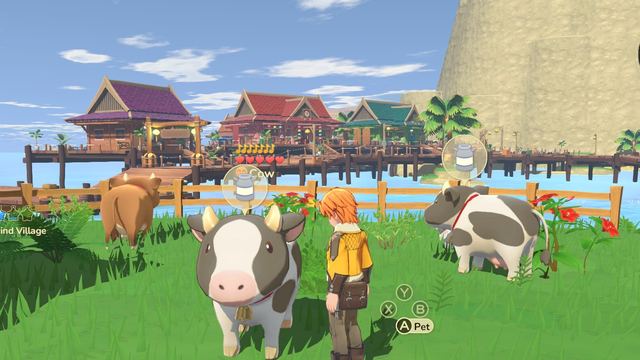
Official launch-trailer frame — travel is cheap once you have a mount; everything else costs stamina.
Rule one: animals beat crops early
Livestock is the strongest early income, for three reasons that compound.
- Hearts rise fast. Feeding and petting an animal daily pushes its heart level up within a handful of in-game days. That is unusually quick for the series.
- High hearts mean top-grade produce. Better eggs, richer milk, more valuable wool.
- It pays every day. A crop gives you one payout when it matures. An animal gives you a payout every morning with no watering involved.
Set against that, a field costs you water, bed space and a season's patience for a single harvest. Early on, the herd wins comfortably.
Rule two: feed for free
Animal feed from weeds costs twenty weeds per feed. Any food item given by hand counts as feeding an animal. Grass planted from seed needs no watering, regrows two or three times, and can be run through the feed maker in bulk.
Choose the free path and your herd's maintenance cost drops to nearly nothing. A farm with zero input cost and daily output is the definition of a good early economy.
Rule three: the bonus cow is worth real money
If you bought on Nintendo or Steam you have the Mooberry Cow Pack; PlayStation 5 and Xbox buyers have Moonana. Either way, the pack's cow produces milk that sells for a multiple of standard milk — creators with early access reported roughly three times the price.
That is a big number on a daily item. The counterweight is that the bonus cow takes a barn slot another species could use. Keep it unless your barn is genuinely full and you are failing quests for wool or eggs.
Where the rest of the money comes from
| Source | Effort | Notes |
|---|---|---|
| Animal produce | Low, daily | The backbone. Milk, eggs, wool |
| Crops | Medium, seasonal | Better as a quest supply than as pure income |
| Crafting | Medium | Wool into cloth and outfits adds value to a herd you already have |
| Quarrytop mining | High | Ore and gems from maze-like caves; deep runs risk item loss |
| Remote islands | High | Treasure hunting and rare animals, gated behind nautical charts |
| Quest rewards | Low | Small individually, but they also pay in Happilia and hearts |
| Fishing | Low | Tidewind's fishing zone gives rewards for a score that resets |
Why not just mine
Mining looks like the obvious money maker — ore and gems out of the caves under Quarrytop — and it is genuinely lucrative. The problem is the risk model. If a wild animal catches you, you lose the items you collected, and everything in your bag is what is on the table.
So mining is a high-variance play: a good cave run pays a lot, a bad one pays nothing. The herd pays a little every day without ever losing a bag. For a first playthrough, build the low-variance income first and treat caves as a bonus, not a salary.
A money plan for the first season
- Tame a horse. Free, and it saves the stamina you would otherwise spend on travel.
- Plant grass somewhere permanent. Free feed forever, plus the sprite handing you three seeds every third day.
- Feed and pet every animal daily. This is the whole investment.
- Finish the bag upgrade quest. Six rows means you can carry produce to sell and forage to keep at the same time.
- Get one of every animal species. Quests ask for eggs, wool and milk, and a missing species is an income leak.
- Keep a stock of everything, sell the tail end. Erratic selling means failing a request, which costs you Happilia and relationship progress.
- Move the farm to your current village. Less walking is more hours, and more hours is more money.
What not to do
- Do not monoculture a single crop. Rotation and soil quality are tracked systems, and one big harvest a season is worse than four modest ones.
- Do not carry a full bag into dangerous terrain. That is the exact inventory you lose.
The supply side of this plan lives on livestock and crops, the routes that make hauling cheap are on map and exploration, and the quest economy that runs alongside money is on Happilia.